
Sketches in India with Natalie Callahan ’23
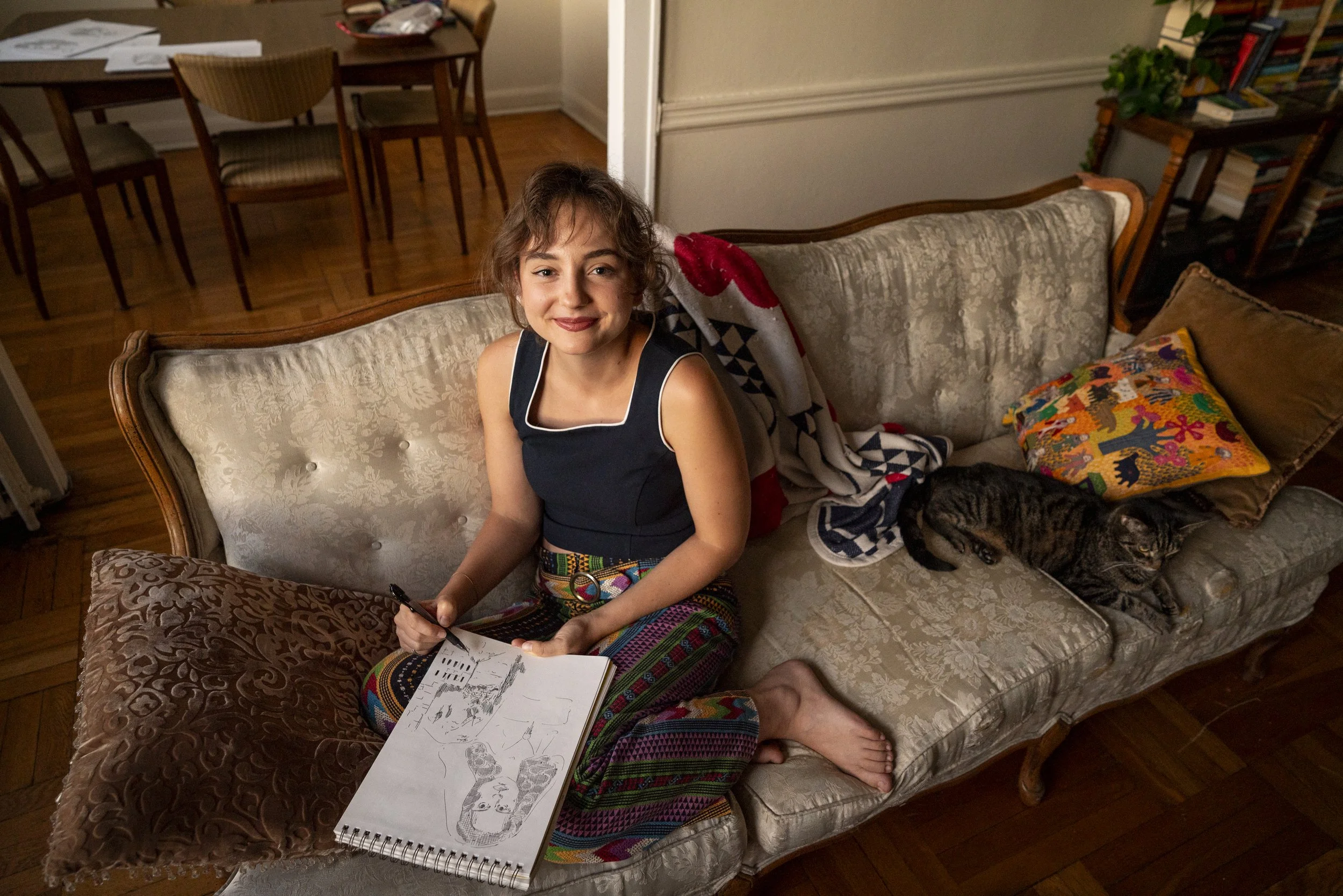
Natalie Callahan poses for a portrait in her apartment while she sketches in her notebook. (Annie O'Neil)
Natalie Callahan ’23 was seated on the back of a scooter, speeding through the streets of Varanasi, her fingernails digging into Ajay’s shoulders.
When he parked, Ajay, her Fulbright scholarship facilitator, joked he’d have to bill the prestigious cultural exchange program for any medical damage caused by her white-knuckle grip.
That was just the beginning of Callahan’s nine months in India on a Fulbright scholarship, which she was awarded after she graduated from Chatham University with a degree in arts management and international studies. She went to Varanasi to do graphite sketches of the people and processes behind Banarasi weaving—a traditional craft known for its intricate designs and its connections to the city’s Muslim community.
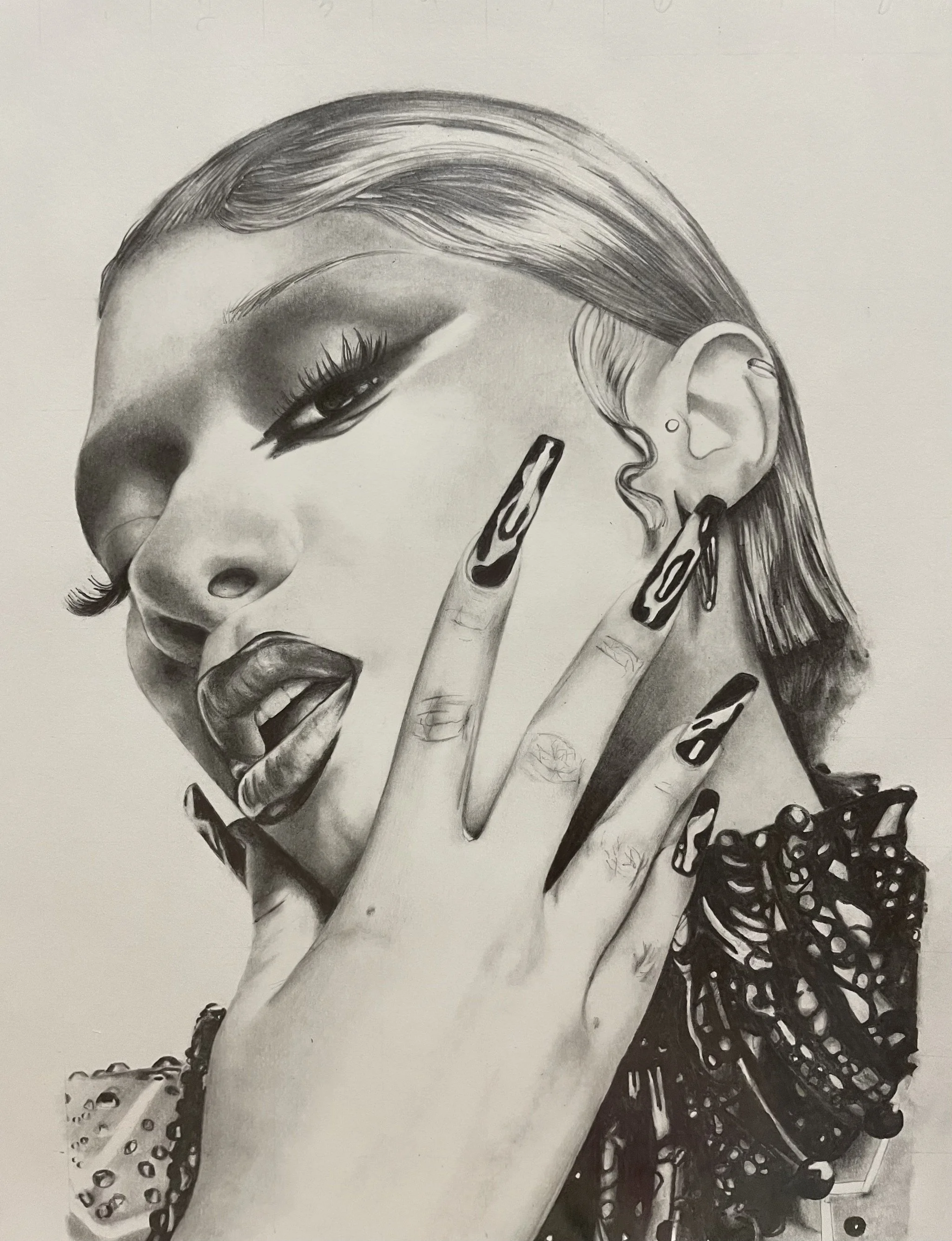
A portrait of the rapper Megan the Stallion was practice for Callahan before beginning her project.
A native of Mount Lebanon in the South Hills of Allegheny County, Callahan learned to do graphite portraits from her high school art teacher, Jennifer Rodriguez. “It was really cool to me that I could get such an accurate picture” from the process, Callahan said. “I was really interested in developing that, because the illusion is really cool, it can look so real.”
Callahan first started thinking about the Fulbright Program during her second year studying arts management at Chatham. She received guidance from Karin Chipman at the Office of Global Engagement, as well as various members of the visual arts faculty at Chatham, who helped guide her ideas, wrote letters of recommendation, and reviewed her submitted materials.
She arrived in Delhi in late August 2024 for her orientation. There, she met about 30 other Fulbright Scholars, each of whom was studying their own subject. “Mine was the only art project,” Callahan said. “Pretty much everyone else was doing really intense research, very STEM-oriented.” The juxtaposition gave her a feeling of imposter syndrome, which she detailed in a blog she updated throughout her project.
“Every time that I decide I want to draw, I am worried that I am not able to draw anymore,” she wrote shortly after arriving in India. “Each time I create a graphite portrait, I worry that the next one will not be as good; this leads to me taking more and more time in between drawings. First it was a month between portraits, then it was three, and now it has been a year.”
She realized he had to start by rebuilding her confidence before she could begin her project in earnest. “Remembering that I do actually enjoy making art was how I ended up tackling that,” Callahan said. “It was a great way to disconnect form the culture shock and the stressors in my environment by doing something that was so familiar to me.”
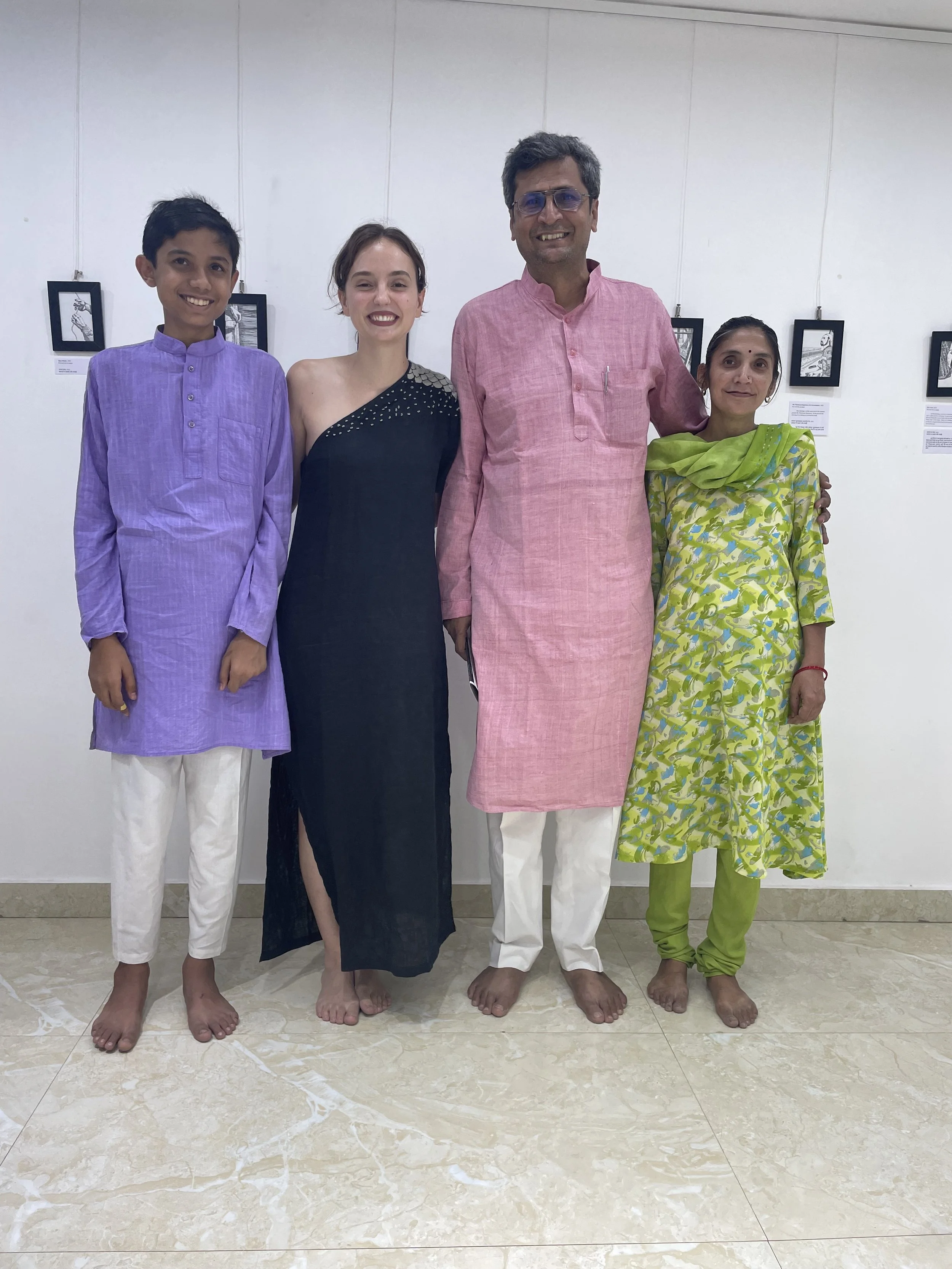
Callahan poses for a photo with her host family. From left: Omesh, her host’s nephew; Callahan; Ajay, her host; and Poonam, Ajay’s sister.
Once she got to Varanasi, she met Ajay, the Fulbright facilitator. Eventually, she began living in an apartment above his home, which allowed her to develop a close friendship with him and his family. He also tutored her in Hindi, introduced her to a translator, and helped connect her with the local weaving community.
“He really took ‘host dad’ to another level,” she said. “He was such a father figure and so funny. He is really well read and knows everything about his city and India in general. I really appreciated his commentary.”
Callahan also did her own background research into the history of the weaving process. “I think that was really important,” she said. Because of that research, “I had an understanding of how ancient the art is and a lot of the modern problems in the industry that the artisans are facing.”
According to some sources, the origins of Banarasi weaving go back nearly 2,000 years, and the trade is passed down through families from generation to generation. Traditionally, women in the industry do not work in the same space as men do. For Callahan, that meant she was speaking almost entirely with men throughout her project. That presented some challenges.
“It was hard to make it seem like I wasn’t intruding on them,” Callahan said. “Having been there for only nine months, it’s hard to make lasting relationships with people you only meet a couple times.”
The first person she met was a man she only referred to as the “Master Weaver” in order to respect his privacy. His family has been in the business for more than 250 years, he told Callahan.
The Master Weaver learned from his father, Callahan said. When was around 15 years old, he would hang around the weavers, watching and learning. When they took breaks, he would jump in and continue their work. That’s how he began to learn the trade himself. “He still believes to this day that there is always something new to learn about the process,” Callahan wrote in her blog.

Part of Callahan’s portrait of the Master Weaver. (Courtesy of Natalie Callahan)
When she visited him, the Master Weaver and his family spread out a plethora of colorful, intricately weaved textile samples for Callahan to observe. Because his workspace was also connected to his house, Callahan then joined him and his family for tea, cookies, and dates that the Master Weaver’s son had brought home from Mecca.
She hadn’t originally planned to sketch a portrait of the Master Weaver for her project, but when she watched him speak, she knew she had to capture his face in graphite.
Was this what she expected to experience when she first started filling out her Fulbright application? Well, Callahan said she tried her best to go into the project with as few preconceived notions as possible.
“If you go in with expectations, it’s harder to learn, because you have to unlearn what you thought and then build on top of that,” she said. “Going in, I did not expect anything, so I could start with a blank slate.”
She spoke to several people in the Banarasi weaving community during her time in the program. Additionally, she gave talks at local colleges and universities, such as Banaras Hindu University and the De Paul Institute of Science and Technology. She also took advantage of the opportunity to travel throughout India, often accompanied by friends she made in the Fulbright program.
The day before she was supposed to return to the United States, Callahan realized she needed another bag. She and Ajay set out on his scooter for a store. She got a new suitcase—a big one. Wearing a dress, she sat side-saddle on the back of the scooter with both her arms wrapped around her large suitcase while Ajay drove them back home.
That brought back memories of their first ride together, when she was clinging to his shoulders like her life depended on it. It was a final reminder of how much her time in India changed her.
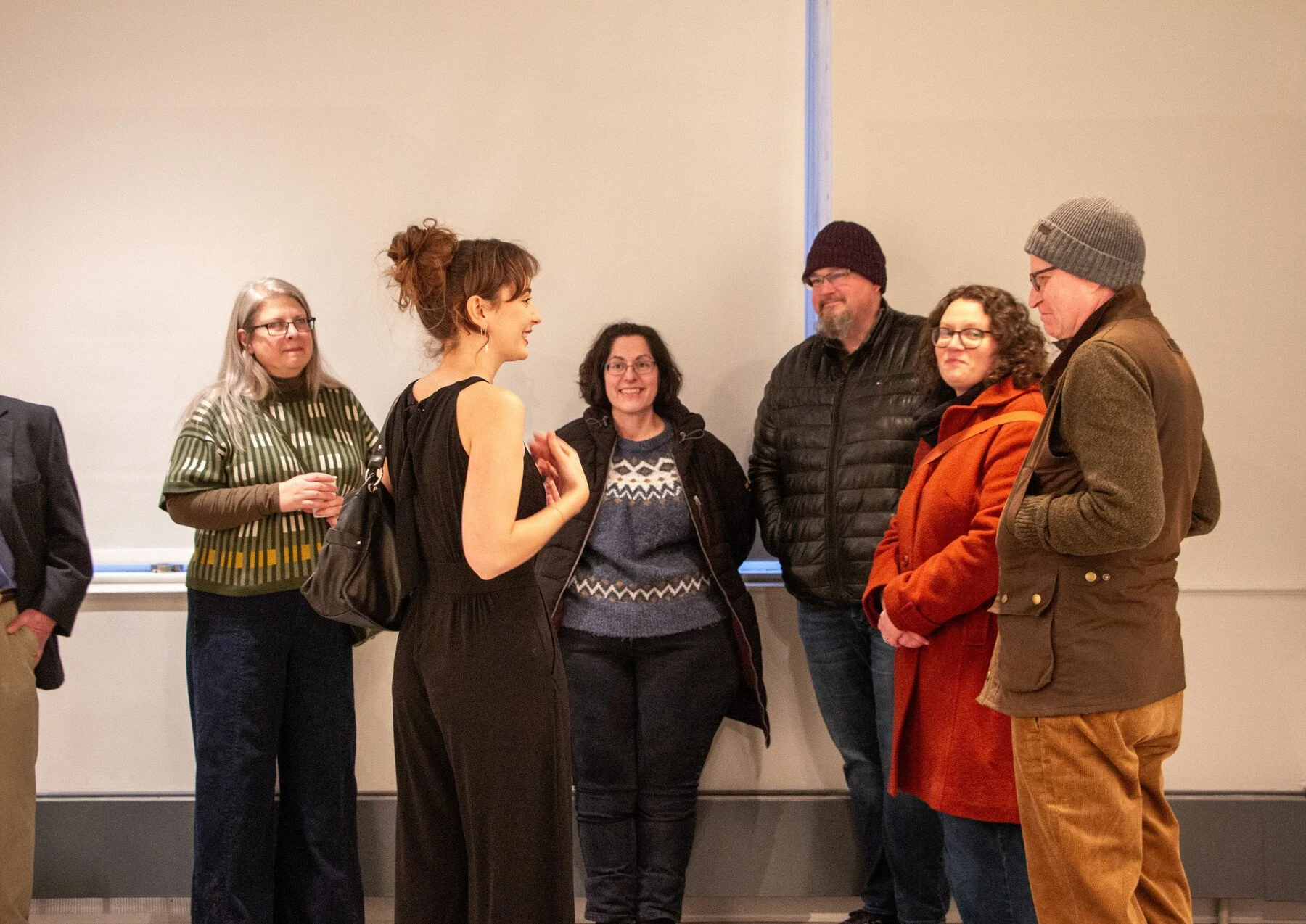
Callahan meets with attendees at the opening of her gallery exhibition, “The Weavers of Benares,” at Chatham. (Ta’Niya-Marie Nored)
After returning to the U.S., Callahan started working at the Carnegie Museum of Art’s Arts Ed Collaborative, an independent project of the museum that works with educators and schools in southwestern Pennsylvania.
“I’m really glad I found this organization that works with arts education,” she said, noting she’s wanted to get into the field for years.
She’s also continued making art, working on new projects and trying different styles, like fantasy illustrations. “I have a very active imagination, but I haven’t been able to figure out how to put that on paper,” she said. She’s taking inspiration from Tony DiTerlizzi, who illustrated and co-authored The Spiderwick Chronicles, one of Callahan’s favorite childhood book series.
Callahan returned to Chatham’s Shadyside Campus this winter for a full-circle moment, when the art she made during her Fulbright grant period was on display in the Susan Bergman Gurrentz ’56 Art Gallery from Jan. 12 – Feb. 27.
This story was originally published in the Winter 2026 issue of the Chatham Recorder alumni magazine.
This story was written by Mick Stinelli.
Mick is the managing editor of the Chatham Recorder alumni magazine and the editorial and communications manager at Chatham University.