
Jake Centra, DPT ’19, Sees the Power of Digital Healthcare
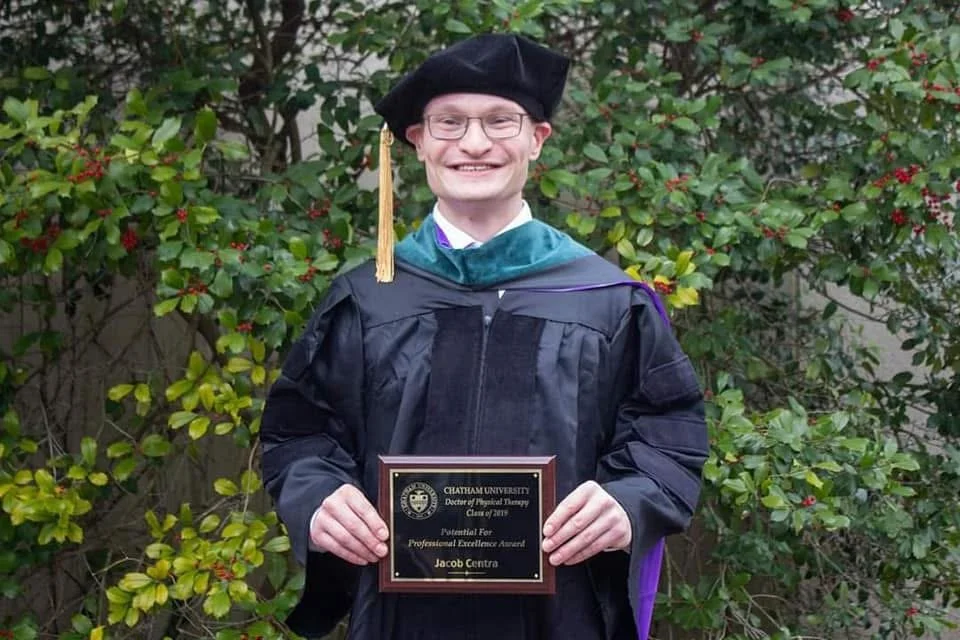
Jake Centra poses with his “Potential for Professional Excellence Award” from Chatham’s DPT program. (Courtesy of Jake Centra)
Jake Centra, DPT ’19, tried to run away from working in technology. His father was a business analyst. His mother worked in IT. And his brother worked as a software engineer.
But when Centra graduated from Chatham University with a Doctor of Physical Therapy (DPT) degree in December 2019, he ended up working digitally amid the spread of COVID-19. So, he rolled with the punches of the pandemic and ended up diving headfirst into digital medicine.
Now, he’s worked at five different startups since graduating, currently working for Atropos Health.
While he couldn’t run away from tech, Centra says he’s glad his career went the way it did after graduating. “I've actually really enjoyed the twists and turns along the way,” Centra says.
Coming to Chatham
Centra, who’s originally from Orange County, NY, first came to western Pennsylvania to study at the University of Pittsburgh. After completing his undergraduate degree, he started looking into studying physical therapy in graduate school.
Chatham, located just down the road from Pitt, stuck out to him for a few reasons. One was its small-campus feel. Another was the problem-based learning (PBL) style offered in the DPT program.
“The draw is hearing that you’ll have less time spent in lecture hours,” Centra says of PBL. “But the reality is, when you’re faced with problems in the real world … you’re not always going to have all the information. It’s not going to be presented in a slide show.”
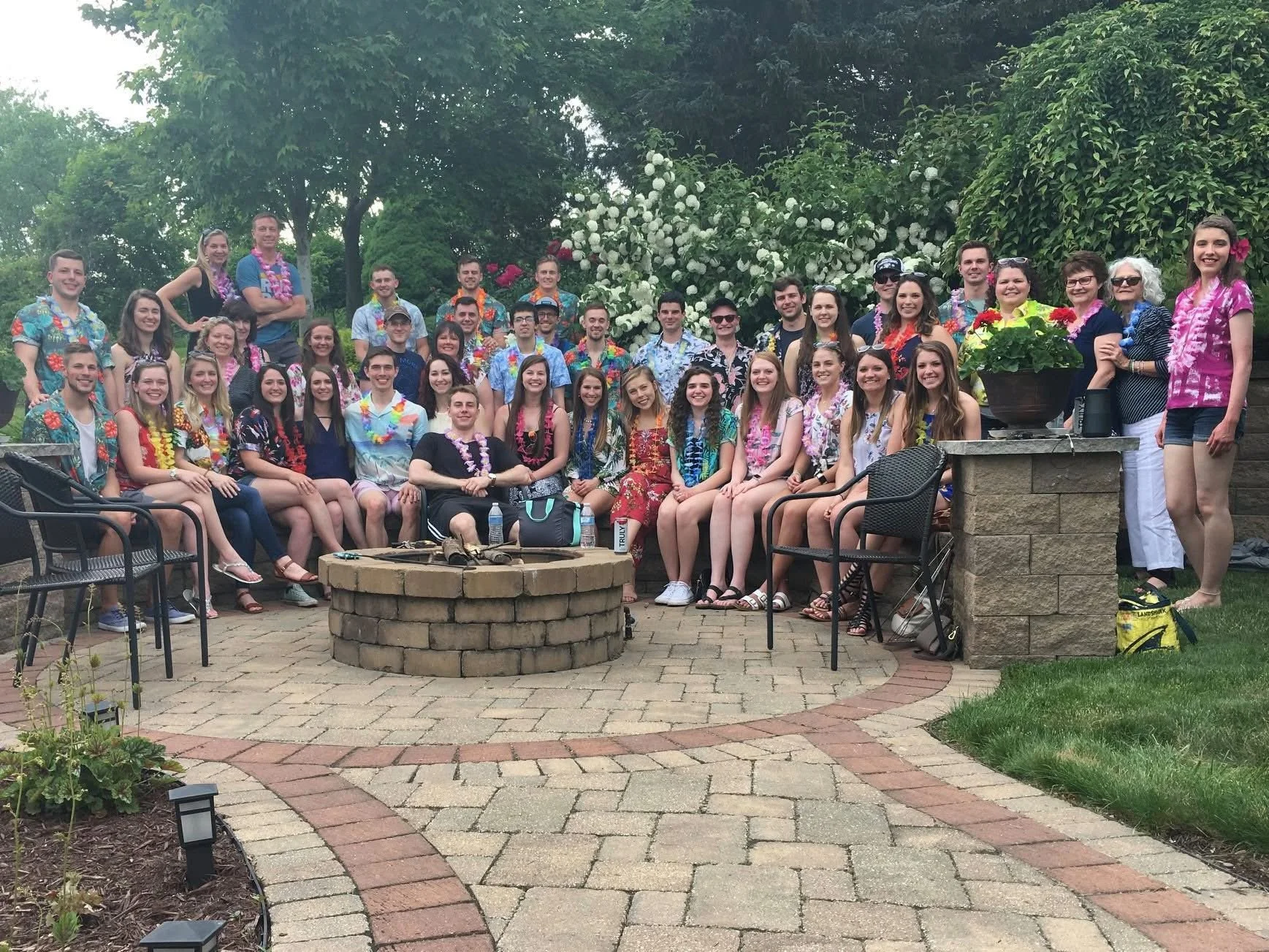
Centra (second row, 10th from right) poses with classmates and faculty at a program party. (Courtesy of Jake Centra)
That’s the strength of PBL; students need to use context, curiosity, and collaboration to solve the problems presented to them—just like if a real patient walked through the door. “I thought that was incredibly unique, and it was a good change of pace and really served me well,” Centra says.
The tuition at Chatham was also lower than what he would’ve paid at a bigger university. “I was able to save a substantial amount of money and graduate a semester sooner by going to Chatham,” Centra says.
Rotations and other experiences
One of Centra’s rotations while at Chatham was in the West Penn Hospital burn unit, working with patients who were recovering from burns. Another rotation he spent in a neonatal intensive care unit.
“I had never changed a diaper before in my life, and there I was looking at a three-pound, premature infant,” he says. “I never thought I'd get that type of opportunity, and I don't take it for granted.
“It really shaped what physical therapy can entail beyond sports rehabilitation, which is what I had envisioned doing with my personal training background.”
“They work really well with you at Chatham in the DPT program to find the right fit of experiences,” Centra says. “I had asked for new, different experiences, and they certainly delivered by helping me to work in those settings.”
Technology found its way into Centra’s Chatham education too; he worked at the IT Help Desk while in school. “Having that opportunity to work where I studied was a great way for a student to make some money but also be able to open and crack open the books when there was some downtime.”
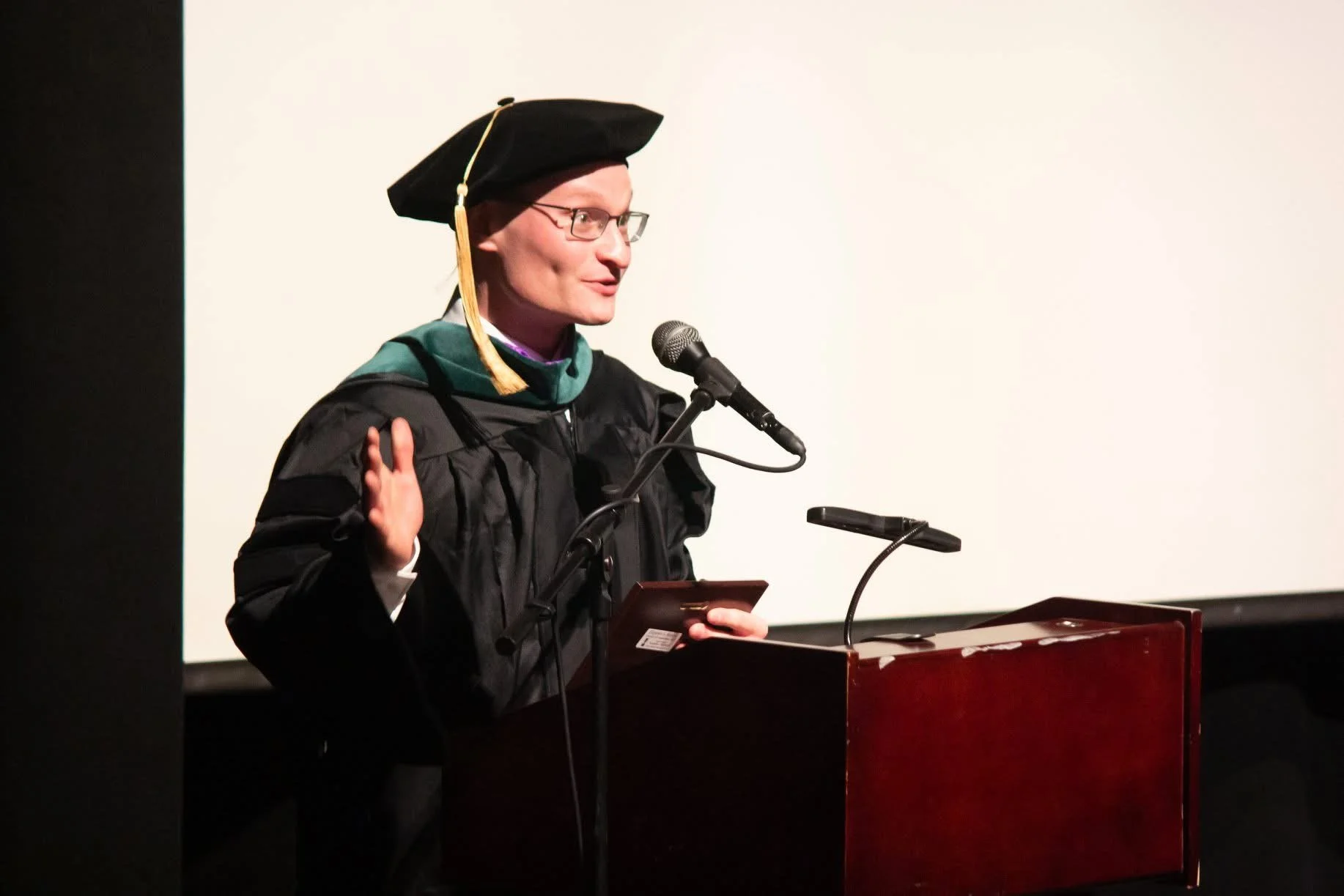
Centra speaks after receiving his DPT program award. (Courtesy of Jake Centra)
Providing virtual care
Entering the PT field in early 2020 meant using digital technology to deliver healthcare was inevitable for Centra, who was mainly treating older adults at that time.
“Once I got exposed to that, the government waived some of the licensing laws about treating across state lines at the time,” Centra says. “I started getting online and prescribing exercise to patients in Florida from my desk in Maryland.”
That was an eye-opening experience. “When you’re treating a person in their own environment, you’re not restricted to the tools you have in a clinic,” he says.
“You have to be careful about what’s safe for them to do without your hands on them. But you are forced to use things in the patient’s environment, where they are trying to be better anyways. They want to be better in their daily life.”
And that’s just one-to-one digital physical therapy. Centra also used artificial intelligence and other technologies to create exercise protocols for patients, working with as many as 80 patients per week at one point. Now, he still works this way with 30 patients a month as a digital physical therapist for Joint Academy.
In his current role with Atropos Health, Centra focuses on making real-world evidence available to life sciences companies for drug development and discovery, to providers for evidence based decision making at the bedside, and for advancing research for all.
Centra also still volunteers for the Academy of Neurologic Physical Therapy, where he co-chairs the online education committee, which is responsible for neurologic continuing education content for physical therapists.
“I get asked a lot why I stay connected with physical therapy even though I’m not treating patients 50 hours a week,” he says. “Being a treatment therapist in a clinic wasn’t my path.
“I still struggle with what’s the right fit for me, but I don’t regret my physical therapy education at Chatham at all. It was transformative. I want to help people understand that there’s so many opportunities out there to leverage that education.”