
Natalie Callahan ’23 Displays Art from Fulbright Experience in On-Campus Exhibit
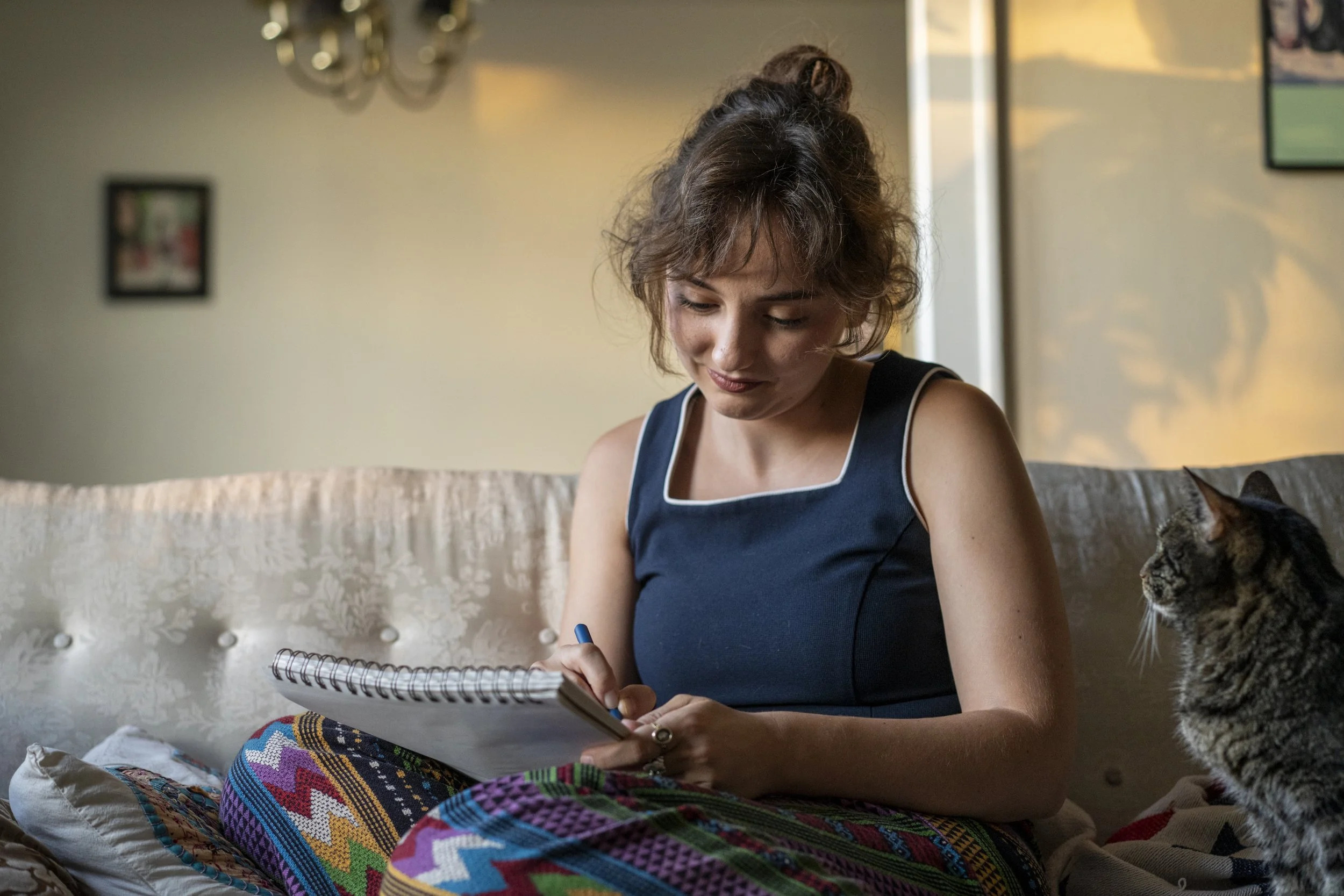
Natalie Callahan sketches in her notebook while her cat watches. (Annie O’Neill)
Natalie Callahan ’23 spent nine months in Varanasi, India on a Fulbright scholarship last year doing graphite sketches of the people and processes behind Banarasi weaving.
It’s a traditional craft known for its intricate designs and its connections to the city’s Muslim community.
Now, her sketches—plus other art she did while in India—are on display in the Susan Bergman Gurrentz '56 Art Gallery starting today. Read the Q&A below to see what Callahan had to say about the trip and the exhibition, which runs through February.
Responses have been edited for concision and clarity.
What is your show, “The Weavers of Benares,” about?
Natalie Callahan: It is a culmination of all the art I made in India. When I was there, all my work was to do with the weaving community local to my city. I was in Varanasi, India, which is in the northeast. Most of the gallery show is related to the weavers and their work.
I wanted to highlight the amount of labor that goes into the art and how much humanity and effort goes into it. I also wanted to reflect that through the hundreds of hours I put into my own artwork.
How did this show come together?
It was part of my original grant application. A big part of the Fulbright is what they call “cross-cultural pollination.” In your application, you need to express how you’ll bring your culture to the country you’re traveling to, and how you’re going to share what you learned and experienced there once you’re back in the U.S.
Since my project was an art project, I always thought a gallery show made sense.
Who did you work with to organize this show?
I worked with the art department at Chatham. This started three years ago, so we’ve been talking about it for a while. At this point, the person who’s been helping me the most is James Louks, [an assistant professor of visual art]. He helped me with my capstone; part of that was a gallery show. It really feels like a full-circle moment. He’s great to work with and has a lot of experience.
Another person is [Chair of Arts, Design, & Communication] Kristen Shaeffer, who’s helped promote things on campus and made sure everything is set up and ready to go.
When I first started working on this three years ago, I had been working with Prajna Paramita Parasher, [professor of art]. She has helped me a lot through the process and wrote me one of my letters of recommendation to the Fulbright Program. When I was still applying to colleges, she interviewed me for Chatham scholarships. She gave me my first tour of the campus.
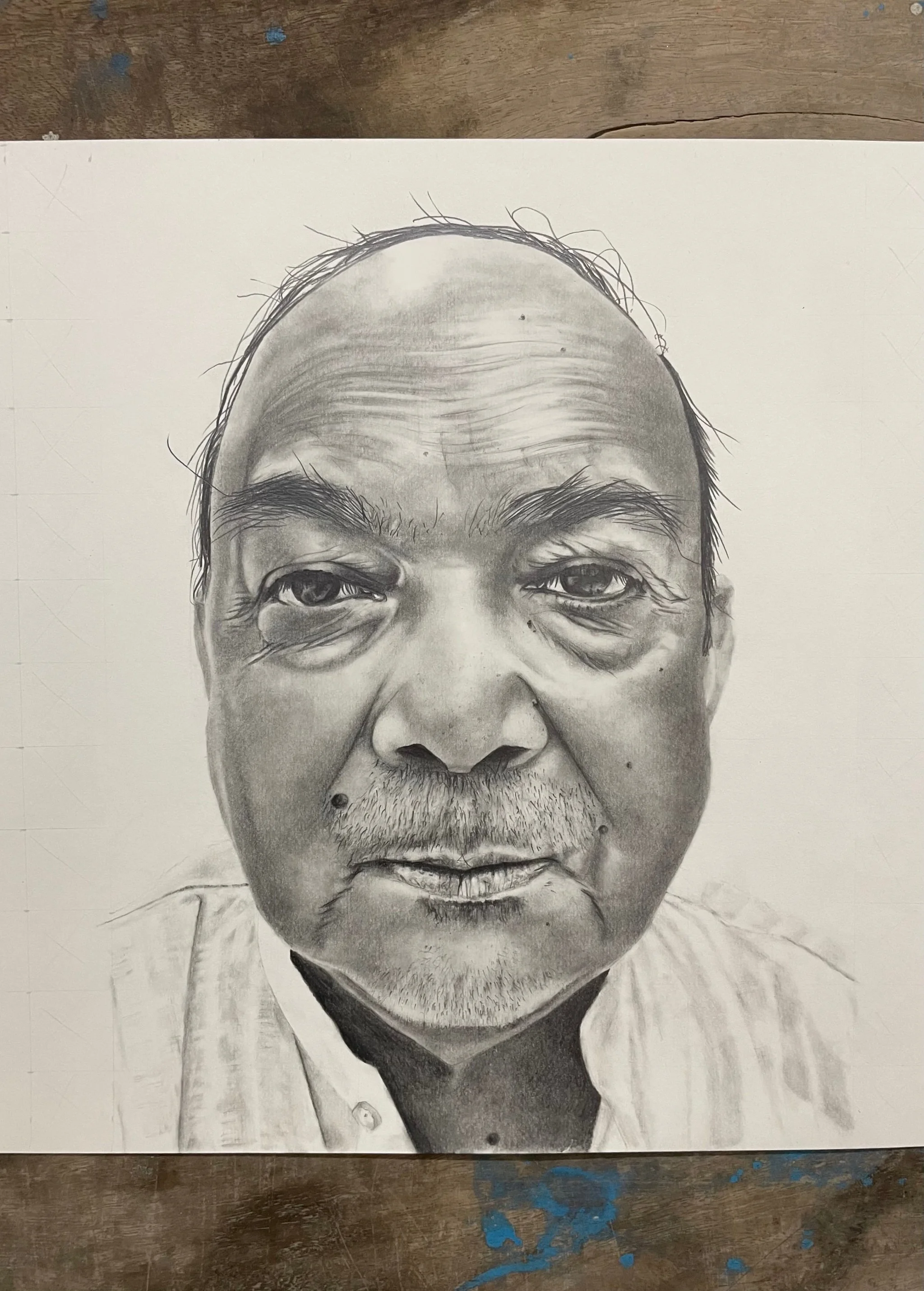
Callahan’s portrait of a master weaver is one of the pieces on display at the show. (Courtesy of Natalie Callahan)
The weavers are the focus of the show, but are there other art pieces that will be on display?
There are a couple. I included some pieces that are more scene setting, like one that depicts a tuk-tuk. That’s how I got around everywhere. When I displayed my art in India, I didn’t have these pieces, because they didn’t need this context. For this show, it makes more sense.
I also did a watercolor painting of a friend that I traveled with throughout India. I didn’t just paint weavers; I was painting everything. So, I put this in the show to give her a shoutout, show that we were both traveling on this grant and doing good work.
What do you hope people who see this show get from it?
I hope they enjoy it. I think my perspective on art is that it should make you feel something. I shouldn’t have to explain it to make you feel something; it should speak for itself.
In depicting people working on art, I want people to understand how integral the human act of making is to art—especially today when we’re dealing with all sorts of AI-generated art and things that remove the human element. I think emotion and reflecting the human experience is what art is about.
The art gallery is in a new space now. Did that impact how you put the show together?
No, but I think it is interesting to think about how the space you’re in helps or hinders the message you’re trying to share. How a space makes or breaks the accessibility of your art and how people interact with it.
You’re thinking about things like, what’s the first thing people are going to see? What direction are they going to walk from there? What do we want to put higher and what do we want people to really be able to look at? How can we play with lights to make sure people are looking at certain things or moving in certain ways?
Is there anything else we should know?
I want people to enjoy the gallery. If they want more information, the brochures in the gallery have more information about the research I was doing, plus a link to the blog I maintained while I was in India.
“The Weavers of Benares” is on display in the Susan Bergman Gurrentz ’56 Art Gallery on Shadyside Campus from Jan. 12 to Feb. 27, 2026.
An opening reception will be held Jan. 15 from 4 – 7 p.m.